Introduction
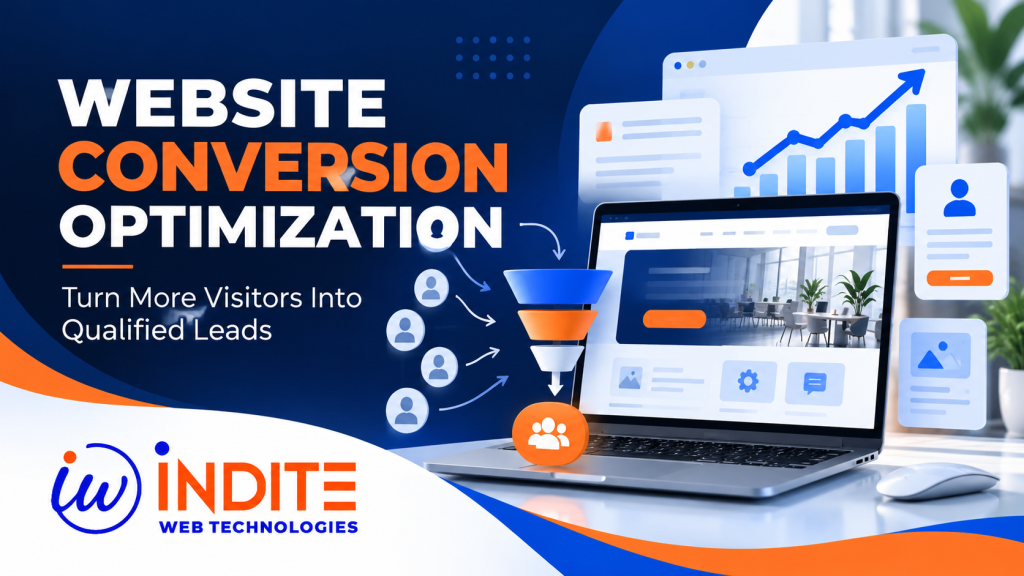
Your website may attract thousands of visitors every month, but how many of them become paying customers?
For many businesses, the challenge is not simply generating website traffic. It is converting that traffic into meaningful enquiries, product purchases, consultation bookings and sales opportunities.
Companies invest in SEO, Google Ads, social media marketing and content creation to attract potential customers. However, when the website experience is confusing, slow or unconvincing, a significant portion of that marketing investment may fail to produce the expected business results.
This is where Conversion Rate Optimization (CRO) becomes important.
CRO is a structured process of understanding visitor behaviour, identifying barriers to conversion and testing improvements that make it easier for people to take the desired action.
For businesses targeting competitive markets such as the United States, United Kingdom, Canada and Australia, a well-optimized website can strengthen the value of existing marketing efforts.
In this guide, we explore how businesses can approach website conversion optimization in 2026, which improvements deserve priority and how to measure whether those changes are actually working.
1. What Is Conversion Rate Optimization?
Conversion Rate Optimization is the process of improving the percentage of website visitors who complete a desired action.
Depending on the business model, a conversion could mean:
- Submitting a contact or quotation request.
- Booking a consultation or appointment.
- Purchasing a product.
- Requesting a product demonstration.
- Downloading a relevant business resource.
- Calling a service provider.
- Registering for a webinar or newsletter.
The right conversion depends on your commercial objective.
For example, a B2B software company may prioritize qualified demonstration requests, while a dental clinic may focus on appointment enquiries. An ecommerce business may concentrate on completed purchases and average order value.
How is conversion rate calculated?
Conversion rate can be calculated as:
Conversion rate = (Conversions ÷ Visitors) × 100
Suppose a business receives 10,000 website visits in one month and generates 200 enquiries.
Its illustrative conversion rate is:
200 ÷ 10,000 × 100 = 2%.
If website improvements increase enquiries to 250 while traffic remains the same, the conversion rate becomes 2.5%.
That represents a 25% relative increase in conversions, although the actual business impact also depends on lead quality, sales conversion and acquisition costs.
This example illustrates why improving the value of existing traffic can be as important as acquiring additional visitors.
2. Why Website Traffic Alone Is Not Enough
Traffic is an important marketing metric, but it does not tell the complete story.
A website can rank well in search results and still generate few enquiries. Paid campaigns can attract visitors who are unlikely to purchase. Social media posts can generate clicks without creating meaningful business opportunities.
Common reasons include:
Poor audience alignment: Visitors arrive expecting something different from what the page offers.
Unclear value proposition: The website describes services without explaining why a customer should choose the business.
Weak calls to action: Visitors cannot easily identify the next step.
Limited trust signals: The website lacks relevant case studies, transparent contact details or credible evidence of experience.
Complicated forms: Potential customers are asked to provide too much information before they can make an enquiry.
Mobile usability problems: Navigation, buttons, images or forms become difficult to use on smaller screens.
Slow or unstable pages: Important information appears late or page elements move unexpectedly.
A conversion-focused strategy examines these barriers instead of assuming that more traffic will automatically solve the problem.
3. Start With the Customer Journey
Before redesigning a website or changing its calls to action, understand how visitors move from discovery to decision.
A typical service-business journey may look like this:
Stage 1: Discovery
A potential customer discovers the business through organic search, paid advertising, a referral or social media.
At this stage, the landing page must immediately communicate relevance.
Stage 2: Evaluation
The visitor reviews services, expertise, pricing information, case studies and other evidence to determine whether the business is suitable.
Content should answer the questions customers actually have rather than merely repeat marketing slogans.
Stage 3: Trust
The visitor evaluates whether the company appears credible, experienced and capable of delivering the promised service.
Clear business information, genuine testimonials, relevant examples and transparent processes can support this decision.
Stage 4: Conversion
The visitor takes the desired action, such as submitting an enquiry or booking a consultation.
The process should be clear, convenient and appropriate to the customer’s stage of readiness.
Stage 5: Follow-up
The business responds promptly, qualifies the enquiry and guides the prospect toward the next step.
Conversion optimization should consider the complete journey. A website that generates a large number of low-quality leads may be less valuable than one that produces fewer, better-qualified opportunities.
4. Improve Your Website’s First Impression
Visitors should be able to understand what your business offers without having to search through multiple pages.
A strong homepage or landing page should communicate three things quickly:
- What the business does.
- Which customers it serves.
- What makes its offering relevant.
Consider a digital marketing agency targeting international businesses.
A generic headline such as “Welcome to Our Website” communicates little about the company’s expertise.
A more specific headline could be:
Digital Marketing Solutions Designed to Support Sustainable Business Growth
Supporting copy could explain the services available, the types of clients served and the outcomes the business aims to support.
The objective is not to make exaggerated promises. It is to help the right visitor recognize that the company understands their needs.
Review your website for unnecessary introductory text, vague headlines, competing messages and decorative elements that distract from the primary objective.
5. Make Calls to Action Clear and Relevant
A call to action (CTA) guides visitors toward the next step.
Examples include:
- Request a Quote
- Book a Consultation
- Schedule a Demo
- View Our Case Studies
- Speak With Our Team
- Get a Website Review
The most effective CTA depends on the visitor’s intent and the complexity of the purchase.
For an expensive B2B service, requesting an immediate purchase may be unrealistic. Offering a consultation or a clearly defined initial assessment may be more appropriate.
For an ecommerce store, a direct purchase action may be suitable when the product, price and delivery information are clear.
Good CTA design should consider placement, wording, visual prominence and the information visitors need before taking action.
Avoid overwhelming users with several competing buttons that all appear equally important. Establish one primary action for each important page and use secondary actions only when they support the customer journey.
6. Reduce Friction in Contact Forms
Contact forms are often one of the most important conversion points on a service website.
Yet many businesses request excessive information before starting a conversation.
Review each form field and ask whether the information is genuinely necessary at the initial enquiry stage.
For example, a simple consultation form might require:
- Name.
- Business email.
- Company website.
- Brief description of the requirement.
Additional fields may be appropriate for complex projects, but unnecessary questions can create avoidable friction.
Other useful improvements include clear field labels, helpful validation messages, mobile-friendly inputs and a confirmation message after submission.
Test the complete form on desktop and mobile devices. Confirm that notifications reach the right team, enquiries are recorded accurately and the next step is communicated to the visitor.
A visually attractive form is not useful if it fails to deliver enquiries to the sales team.
7. Improve Website Speed and User Experience
Performance affects how visitors experience a website. A slow or unstable page can make it harder for users to access information and complete actions.
Google’s Core Web Vitals provide useful measures of real-world user experience:
- Largest Contentful Paint (LCP): Measures loading performance. A good target is 2.5 seconds or less.
- Interaction to Next Paint (INP): Measures responsiveness. A good target is 200 milliseconds or less.
- Cumulative Layout Shift (CLS): Measures visual stability. A good target is 0.1 or less.
These targets should be evaluated using the appropriate field data and testing tools. Passing them does not guarantee higher rankings or better conversion rates, but it provides useful evidence about the website experience.
Potential improvements include optimizing large images, reducing unnecessary scripts, improving caching, reviewing hosting performance and ensuring that fonts and page elements load predictably.
Use Google PageSpeed Insights and the Core Web Vitals report in Search Console to identify issues and monitor progress.
Source: Google Search Central — Core Web Vitals.
8. Build Trust With Evidence, Not Just Claims
Visitors evaluating a business often need evidence that it can deliver what it promises.
A conversion-focused website should make that evidence easy to find.
Useful trust elements may include:
Relevant case studies: Explain the client’s challenge, the work performed and the measured outcome. Obtain permission before publishing identifiable client information.
Testimonials: Use genuine statements from real customers and present them accurately.
Clear service descriptions: Explain what is included, how the process works and what the client can expect.
Transparent business information: Provide accurate contact details, company information and relevant policies.
Expertise and experience: Demonstrate knowledge through useful articles, practical resources and detailed explanations.
Avoid fabricated reviews, misleading client logos, unsubstantiated performance claims or guarantees that cannot reasonably be supported.
Trust is not created by adding badges to a page. It comes from providing consistent, credible evidence throughout the customer journey.
9. Match Landing Pages to Marketing Campaigns
One common mistake is sending every paid advertising or email campaign visitor to the homepage.
A homepage serves multiple audiences and objectives. A campaign-specific landing page can address a much narrower need.
For example, a company advertising commercial cleaning services should direct interested visitors to a relevant page explaining the service, coverage area, process and quotation options.
A company advertising AI SEO services should provide information about the specific problems the service addresses, the scope of the engagement and how success will be evaluated.
Landing pages should maintain consistency between the original advertisement and the destination page.
If an advertisement promises a particular service, the landing page should address that service immediately rather than requiring visitors to navigate through unrelated content.
This alignment can help visitors assess relevance more quickly and makes campaign performance easier to evaluate.
10. Use Data and Testing Instead of Guesswork
Conversion optimization should be treated as a measurable improvement process rather than a series of subjective design changes.
Begin by collecting a baseline and identifying the largest sources of friction.
Useful data sources include:
- Google Analytics 4 for traffic and conversion events.
- Google Search Console for organic search performance.
- PageSpeed Insights for performance diagnostics.
- Session recordings and heatmaps, where appropriately configured and privacy-compliant.
- Customer interviews and sales-team feedback.
- CRM data showing lead quality and sales outcomes.
What should you test?
Potential experiments include:
- A specific headline versus a more general headline.
- A shorter form versus a longer form.
- A prominent CTA versus a less visible one.
- A case study near the CTA versus a case study lower on the page.
- Different page layouts for different audience segments.
Prioritize tests based on the potential business impact, confidence in the underlying problem and implementation effort.
Change one major variable at a time when practical, use suitable experiment designs and avoid declaring a winner based on a handful of conversions.
Where website traffic is limited, structured usability testing and qualitative feedback may be more useful than attempting to run underpowered A/B tests.
Also measure qualified enquiries and revenue where possible. A design that increases form submissions but attracts unsuitable leads may not improve commercial performance.
11. A Practical 90-Day Conversion Optimization Plan
A structured roadmap can help businesses move from assumptions to measurable improvements.
Days 1–30: Audit and establish a baseline
- Review traffic sources and existing conversion data.
- Identify important landing pages and customer journeys.
- Test contact forms, booking processes and mobile usability.
- Review website performance and technical issues.
- Gather feedback from customers and sales teams.
- Document the most important conversion barriers.
Expected deliverable: A prioritized conversion improvement plan with baseline metrics.
Days 31–60: Implement high-priority improvements
- Clarify headlines and value propositions.
- Improve the visibility and relevance of primary CTAs.
- Simplify forms where possible.
- Improve mobile layouts and navigation.
- Address significant performance and usability problems.
- Strengthen relevant trust signals and supporting content.
Expected deliverable: Improved priority pages and a reliable conversion tracking setup.
Days 61–90: Test and refine
- Test suitable changes against the baseline.
- Review conversion rates by traffic source and device.
- Examine the quality of enquiries generated.
- Identify additional friction points.
- Document findings and plan the next optimization cycle.
Expected deliverable: A measurement-based optimization roadmap informed by observed user behaviour.
The 90-day period is a practical planning framework, not a guarantee of a particular conversion increase. Results depend on traffic quality, the existing website, the market, the offer and the quality of implementation.
12. Common Conversion Optimization Mistakes
Businesses should avoid several common mistakes when trying to improve website performance.
Redesigning without research: A new design may look modern but still fail to address the reasons visitors leave.
Copying competitors: Competitors may have different audiences, offers and customer journeys. Their designs are not automatically appropriate for your business.
Focusing only on button colors: Small visual changes rarely solve deeper issues involving unclear value propositions, weak offers or poor trust.
Ignoring mobile visitors: Forms, navigation and calls to action must work properly on smaller screens.
Tracking only total leads: Lead quality, qualification rates and sales outcomes are essential to evaluating commercial success.
Making too many changes at once: When multiple elements change simultaneously, it becomes difficult to understand which changes influenced the result.
Ignoring privacy: Analytics, session recording and experimentation tools should be configured in accordance with applicable privacy requirements and consent obligations.
A successful optimization program focuses on the underlying customer problem, not simply on making the website look different.
Conclusion: Turn Your Website Into a More Effective Business Asset
A website should do more than present information about a company. It should help potential customers understand the offering, evaluate their options and take the next appropriate step.
Conversion Rate Optimization helps businesses identify and remove obstacles that prevent visitors from becoming meaningful opportunities.
By improving messaging, calls to action, forms, page performance, trust signals and measurement, businesses can make better use of their existing marketing investment.
At Indite Web Technologies, we help businesses strengthen their digital presence through website design and development, SEO, digital marketing and ongoing website optimization.
If your website attracts visitors but does not generate the enquiries or sales opportunities you expect, a structured review can help identify where improvements may be worthwhile.
Visit Indite Web Technologies to explore how website development, SEO and digital marketing can support your business growth.
What is website conversion rate optimization?
Website Conversion Rate Optimization is the process of improving the percentage of visitors who complete a desired action, such as submitting an enquiry, booking a consultation or purchasing a product.
How can I improve my website conversion rate?
Start by understanding visitor behaviour, clarifying your value proposition, improving mobile usability, simplifying forms, strengthening trust signals and testing changes against a reliable baseline.
Does website speed affect conversions?
Website performance influences the user experience and can make it easier or harder for visitors to interact with a page. Its actual effect on conversions should be measured for your website rather than assumed.
What is a good website conversion rate?
There is no single conversion rate that is appropriate for every business. Performance varies by industry, traffic source, offer, device and conversion definition. Compare results with relevant benchmarks where available and prioritize improvements against your own baseline.
How long does conversion rate optimization take?
Some technical or usability problems can be corrected quickly, but reliable performance evaluation may require more time and sufficient data. A 90-day program provides a useful framework for auditing, implementing and evaluating improvements.
Can SEO and conversion rate optimization work together?
Yes. SEO helps attract relevant organic traffic, while conversion optimization focuses on helping visitors take appropriate actions. Combining the two can create a more complete digital growth strategy, although outcomes depend on execution and market conditions.