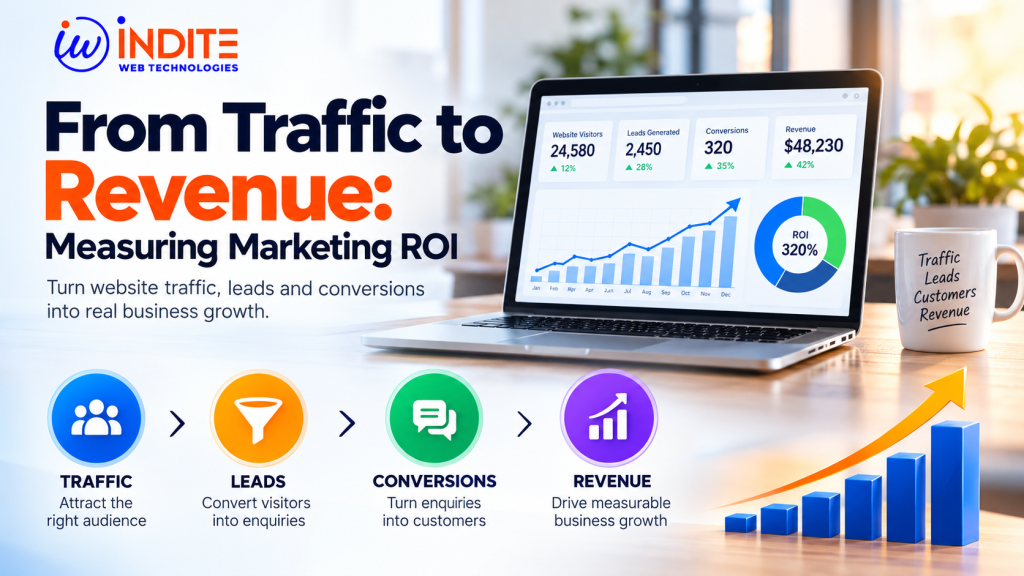
Every business wants more website traffic, better search rankings, and stronger online visibility. But an important question often gets overlooked: Is your digital marketing actually generating revenue?
Website visits, social media engagement, and advertising clicks are useful indicators, but they don’t tell the whole story. Real marketing success comes from turning these activities into qualified leads, paying customers, and measurable business growth.
In this guide, we explain how to measure digital marketing ROI and identify the strategies that deliver the greatest business value.
What Is Marketing ROI?
Marketing ROI (Return on Investment) measures the return generated by marketing activities compared with their cost.
The basic formula is:
Marketing ROI = (Marketing Revenue − Marketing Cost) ÷ Marketing Cost × 100
For example, if your business invests $5,000 in marketing and generates $15,000 in attributable revenue, the simplified marketing ROI is 200%.
Remember that revenue is not profit. For a more accurate profitability assessment, consider delivery costs, salaries, and other relevant expenses.
Why Website Traffic Alone Is Not Enough
High website traffic doesn’t always mean high revenue. Visitors may leave without making an enquiry, purchasing a product, or contacting your business.
For example, one website might attract 10,000 visitors but generate very few leads, while another attracts 3,000 visitors and converts a much higher percentage into customers.
This is why businesses should focus on attracting the right audience, improving user experience, and encouraging meaningful conversions.
6 Important Metrics to Measure Digital Marketing ROI
1. Website Conversion Rate
This measures the percentage of visitors who complete an action, such as submitting a contact form or requesting a quotation.
Formula: Conversions ÷ Visitors × 100
Improve conversion rates with clear calls to action, simple forms, relevant content, and a mobile-friendly website.
2. Cost Per Lead (CPL)
Cost per lead shows how much you spend to generate an enquiry.
Formula: Marketing Cost ÷ Number of Leads
However, a low cost per lead is only valuable when those leads are relevant and likely to become customers.
3. Customer Acquisition Cost (CAC)
CAC measures how much it costs to acquire a new customer, including relevant marketing and sales expenses.
Tracking CAC helps businesses understand whether customer acquisition is financially sustainable.
4. Revenue by Marketing Channel
Identify which channels contribute to leads and sales, including SEO, Google Ads, social media, email marketing, and content marketing.
Use analytics and CRM data to understand which channels attract valuable customers, rather than simply generating clicks.
5. Return on Ad Spend (ROAS)
ROAS measures revenue attributed to advertising compared with advertising expenditure.
Formula: Revenue Attributed to Ads ÷ Advertising Spend
For example, $10,000 in attributed revenue from $2,000 in ad spend gives a ROAS of 5:1. This does not automatically mean the campaign is profitable, as other costs must also be considered.
6. Customer Lifetime Value (CLV)
Customer lifetime value estimates the revenue or profit a customer generates throughout their relationship with your business.
Comparing lifetime value with customer acquisition cost can help you evaluate long-term growth potential.
How to Measure ROI Across Different Digital Marketing Channels
Different marketing channels require different performance indicators.
- SEO: Track organic traffic, qualified enquiries, conversions, and attributable revenue.
- Google Ads: Monitor conversion rates, cost per qualified lead, customer acquisition cost, and ROAS.
- Social media marketing: Measure relevant engagement, website visits, enquiries, and sales.
- Content marketing: Evaluate organic visibility, lead generation, assisted conversions, and business opportunities.
- AI search and GEO: Monitor identifiable AI referrals, relevant brand mentions, website visits, and conversions where measurable.
AI search visibility is becoming an important consideration, but attribution can be difficult. Businesses should evaluate it alongside established SEO and revenue metrics rather than relying on visibility alone.
5 Steps to Improve Your Marketing ROI
1. Set clear business goals. Decide whether you want more qualified leads, online sales, or lower acquisition costs.
2. Track conversions accurately. Use tools such as Google Analytics 4, Google Search Console, advertising conversion tracking, and CRM software.
3. Connect leads with sales. Track enquiries from their initial source through to becoming paying customers.
4. Review campaign performance. Identify which channels generate quality leads and meaningful business results.
5. Optimise continuously. Improve landing pages, audience targeting, content quality, calls to action, and follow-up processes based on reliable data.
Common Marketing ROI Mistakes to Avoid
Businesses often make avoidable mistakes when evaluating marketing performance:
- Focusing only on traffic, impressions, or social media likes.
- Ignoring lead quality and sales conversion rates.
- Confusing revenue with profit.
- Judging SEO and content marketing too early.
- Relying entirely on last-click attribution.
- Making decisions using incomplete or inaccurate tracking data.
A consistent measurement framework helps businesses make more informed marketing decisions.
Conclusion: Turn Marketing Activity into Business Growth
Digital marketing should do more than increase website traffic. It should help businesses attract relevant audiences, build trust, generate qualified leads, and increase revenue.
By tracking the right metrics, connecting marketing data with sales outcomes, and continuously improving campaigns, businesses can make better use of their marketing budgets.
At Indite Web Technologies, we help businesses strengthen their online presence through website development, SEO, AI search optimization, Google Ads, and digital marketing services.
Our focus is on helping businesses build a stronger digital foundation and make informed decisions that support sustainable growth.
Ready to improve your digital marketing performance?
Visit Indite Web Technologies to explore our services and discuss your business goals.