By Ravi | Founder, Indite Web Technologies
For many years, search engine optimization had one clear goal: get your website to rank higher on Google.
Businesses invested in keywords, backlinks, blogs, technical SEO, and content strategies because the formula was fairly easy to understand. If your website appeared on the first page of Google, especially in the top few results, you had a strong chance of getting traffic, leads, and customers.
But today, search is changing.
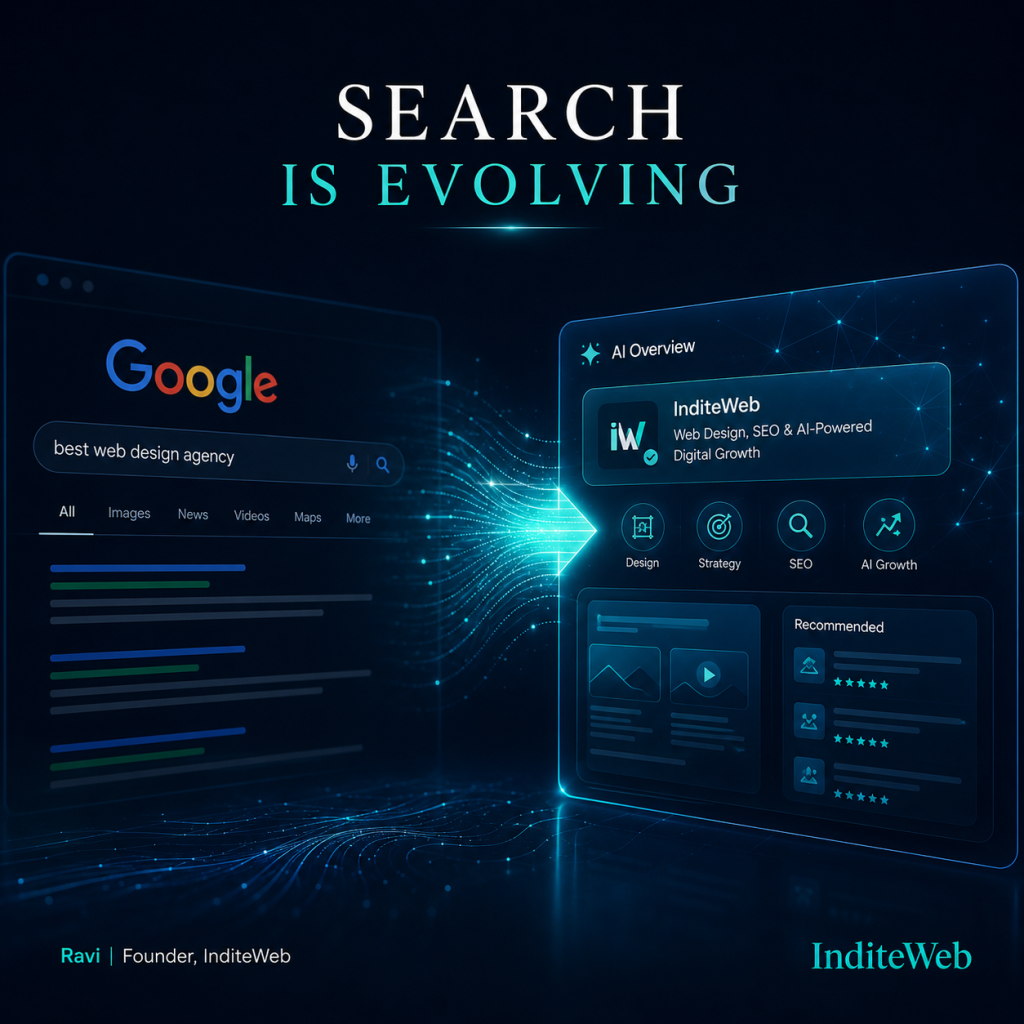
Google is no longer only a search engine that shows blue links. It is slowly becoming an AI-powered answer engine.
With AI Overviews, AI Mode, and generative search experiences, users are no longer searching the same way they used to. They are asking longer questions, comparing options, looking for direct explanations, and expecting Google to summarize the best possible answer for them. Google’s own documentation now explains that AI features like AI Overviews and AI Mode are part of the search experience and can show supporting links from the web.
This shift is creating a new layer of digital visibility.
That layer is called GEO — Generative Engine Optimization.
What Is GEO?
GEO stands for Generative Engine Optimization.
In simple words, GEO is the process of preparing your website, content, brand, and digital presence so that AI-powered search engines can understand, trust, reference, and recommend your business.
Traditional SEO was mainly about ranking on search result pages.
GEO is about being recognized inside AI-generated answers.
This does not mean SEO is dead. In fact, Google has clearly stated that SEO best practices remain relevant for generative AI search because AI features in Search are still rooted in Google’s core search ranking and quality systems. Google also mentions that terms like AEO and GEO are commonly used in the industry, but from Google’s point of view, optimizing for generative AI search is still part of optimizing for the overall search experience.
So, the real point is not SEO versus GEO.
The real point is this:
SEO helps your website get found. GEO helps your brand get understood, trusted, and cited.
Why Google Search Is Changing
The way people search has changed dramatically.
Earlier, a user might search:
“best website design company”
Now, the same user may search:
“Which web design agency is best for a growing eCommerce business that needs SEO, branding, and conversion-focused development?”
This is a very different kind of search.
It is more detailed.
It is more intent-driven.
It expects a direct answer.
It requires deeper understanding.
Google’s AI Mode is built for these kinds of deeper questions. Google describes AI Mode as useful for nuanced questions, complex comparisons, and follow-up exploration, with AI-powered responses and supporting links.
This means businesses can no longer create thin, generic, keyword-stuffed content and expect long-term visibility.
Google is looking for content that is useful, reliable, well-structured, and created for people first. Google’s helpful content guidance says its systems are designed to prioritize helpful and reliable information created to benefit people, not content made only to manipulate rankings.
That is the foundation of the new search era.
From Ranking to Being Recommended
For years, businesses asked one main question:
“How do we rank higher on Google?”
Today, the better question is:
“How do we become the brand that Google’s AI can confidently recommend?”
That is a major mindset shift.
Ranking is still important, but AI search changes how users discover information. Instead of only scanning a list of websites, users may now see a summarized answer, product comparison, brand recommendation, local suggestion, or service explanation directly inside Google.
This means your content has to do more than include keywords.
It has to clearly explain who you are, what you do, who you help, why you are credible, and what makes your solution valuable.
If your content is unclear, generic, or disconnected, AI systems may not understand your brand properly.
But if your website has strong service pages, helpful blogs, clear expertise, case studies, FAQs, structured content, strong internal linking, and consistent brand signals, your chances of being understood improve.
In the future of search, clarity becomes a competitive advantage.
SEO Is Not Dead. It Is Evolving.
Every time Google changes, people say SEO is dead.
But SEO has never really died. It has only evolved.
There was a time when keyword stuffing worked. Then Google became smarter.
There was a time when low-quality backlinks worked. Then Google became stricter.
There was a time when generic blogs could rank easily. Then Google started rewarding more useful and original content.
Now, with AI-powered search, SEO is entering another evolution.
The fundamentals still matter:
Your website must be crawlable.
Your pages must be indexable.
Your content must be helpful.
Your site must load properly.
Your internal linking must be clear.
Your brand must be trustworthy.
Your pages must answer real user intent.
Google’s AI guidance also mentions that a clear technical structure, crawlability, valuable content, page experience, and textual content remain important for visibility in AI search features.
So GEO does not replace SEO.
GEO builds on SEO.
Think of it this way:
SEO is the foundation. GEO is the future-facing layer built on top of it.
What Businesses Need to Focus on Now
The businesses that will win in this new search environment are not necessarily the ones publishing the most content.
They will be the ones publishing the clearest, most useful, most credible, and most experience-driven content.
Here are the key areas businesses should focus on.
- Build Content Around Real Questions
AI-powered search is designed to answer questions.
That means your website should not only talk about your services. It should answer the questions your customers are actually asking.
For example, instead of only having a page called “SEO Services,” a business should also answer:
What does SEO include?
How long does SEO take?
How does SEO help a small business grow?
What is the difference between SEO and paid ads?
How does AI search affect SEO?
How should businesses prepare for GEO?
This kind of content helps users, but it also gives search engines and AI systems more context about your expertise.
- Create Non-Generic Content
Generic content is becoming weaker.
If your blog says the same thing as hundreds of other websites, there is very little reason for Google or AI systems to treat it as valuable.
Google’s guidance for generative AI search specifically encourages unique, valuable, non-commodity content that provides a real point of view and does not simply recycle what already exists online.
This is where founder-led content becomes powerful.
A founder can share perspective, experience, market observations, client learnings, mistakes, strategies, and real insights. That kind of content feels human. It builds trust. It gives AI more meaningful information to understand the brand.
For example, a founder saying, “This is what I am seeing in the market,” is much stronger than another generic article titled, “10 Benefits of SEO.”
- Strengthen Brand Authority
In AI search, your brand cannot depend only on your website.
Your digital footprint matters.
That includes your website, blogs, LinkedIn presence, Google Business Profile, reviews, case studies, guest mentions, portfolio, testimonials, social media, and third-party references.
When your brand is consistently represented across platforms, it becomes easier for search systems to understand who you are and what you are known for.
For a digital agency like InditeWeb, this means clearly communicating expertise in web design, development, SEO, online branding, content writing, and AI-enhanced digital strategies. InditeWeb’s website already positions the company around web design, development, online branding, SEO, and AI-enhanced digital strategies.
The stronger and clearer the brand presence, the better the long-term visibility.
- Make Your Website Easy to Understand
A beautiful website is important, but in the AI search era, a clear website is even more important.
Your site should clearly explain:
Who you are.
What services you offer.
Who you serve.
What problems you solve.
Why clients should trust you.
What results you help create.
How users can take the next step.
Your headings, service pages, FAQs, case studies, schema, internal links, and content structure should all support this clarity.
If a human visitor cannot quickly understand your business, AI systems may also struggle to understand it.
- Focus on Helpful, People-First Content
The future of content is not about writing for bots.
It is about writing so clearly for people that search engines can also understand it.
This means your content should be simple, useful, practical, and trustworthy.
Avoid creating content only to target keywords. Avoid publishing blogs just because competitors are doing it. Avoid using AI to mass-produce low-value pages.
Google’s guidance says that if generative AI tools are used in content creation, the work should still meet Search Essentials and spam policies. The focus should remain on helpful content, not scaled content created without real value.
In short, AI can help create content, but human strategy and expertise must lead it.
What GEO Means for Service-Based Businesses
For service-based businesses, GEO is especially important.
Why?
Because service decisions usually involve trust.
A customer looking for a web design agency, SEO company, marketing consultant, lawyer, dentist, real estate agent, or contractor does not simply want a list of options. They want guidance. They want comparison. They want confidence.
AI search will increasingly help users shortlist, compare, and understand service providers.
That means service businesses must become more visible as trusted experts, not just vendors.
Your website should include:
Detailed service pages
Strong FAQs
Founder-led insights
Client success stories
Portfolio pages
Industry-specific pages
Educational blogs
Clear process explanations
Trust signals
Reviews and testimonials
Local or global service positioning
This helps both users and search systems understand your credibility.
The Future Belongs to Brands That Are Understood
In the old search world, visibility was about ranking.
In the new search world, visibility is about meaning.
Google and AI-powered platforms need to understand your brand deeply enough to connect it with the right questions.
That means businesses should stop thinking only in terms of keywords and start thinking in terms of entities, authority, expertise, and trust.
Your brand should be clearly associated with your niche.
If you are a web design agency, Google should understand that.
If you are an SEO agency, Google should understand that.
If you serve eCommerce brands, healthcare businesses, real estate companies, or local service providers, Google should understand that.
If you specialize in AI-enhanced marketing strategies, Google should understand that too.
The clearer your positioning, the stronger your discoverability.
GEO Is Not a Shortcut
One important thing to understand is that GEO is not a hack.
It is not about adding one file, one plugin, or one magic schema code.
Google’s own guidance warns against overfocusing on unsupported “GEO hacks” such as special AI text files, unnecessary chunking, or inauthentic mentions for Google Search. Google recommends focusing on strong SEO fundamentals, unique content, and helpful user experiences instead.
That is why businesses should be careful.
GEO should not be treated as a shortcut. It should be treated as a smarter content and visibility strategy.
The goal is not to trick AI.
The goal is to become genuinely useful and easy to understand.
How Businesses Should Prepare for GEO
The best way to prepare for GEO is to strengthen the foundation first.
Start by auditing your website.
Is your website technically clean?
Are your service pages detailed enough?
Do you have strong internal linking?
Are you answering real customer questions?
Is your content original or generic?
Do you have case studies and proof?
Is your brand active outside your website?
Are your pages structured clearly?
Does your website load well on mobile?
Are you building authority consistently?
Once these basics are in place, businesses can start building deeper GEO-focused content.
That includes:
Topic clusters
Founder insights
Comparison blogs
FAQs
Industry-specific guides
Case studies
Educational resources
AI-search-friendly service pages
Clear brand positioning
High-quality visuals and videos
This is how brands can prepare for both traditional search and AI-powered discovery.
Final Thoughts
As a founder, I believe we are entering one of the most important shifts in digital marketing.
Google is changing.
Search behaviour is changing.
Users are asking better questions.
AI is becoming part of the discovery journey.
And businesses that rely only on old SEO methods may slowly lose visibility to brands that are clearer, more helpful, and more trusted.
GEO is not about abandoning SEO.
It is about evolving with search.
The brands that win in the next phase of Google will be the ones that create meaningful content, build strong authority, improve technical clarity, and position themselves as trusted voices in their industry.
At Indite Web Technologies, this is how we look at the future of digital growth.
SEO helped businesses get ranked.
GEO will help businesses get recognized, referenced, and trusted.
And that is the next shift every business should start preparing for.